
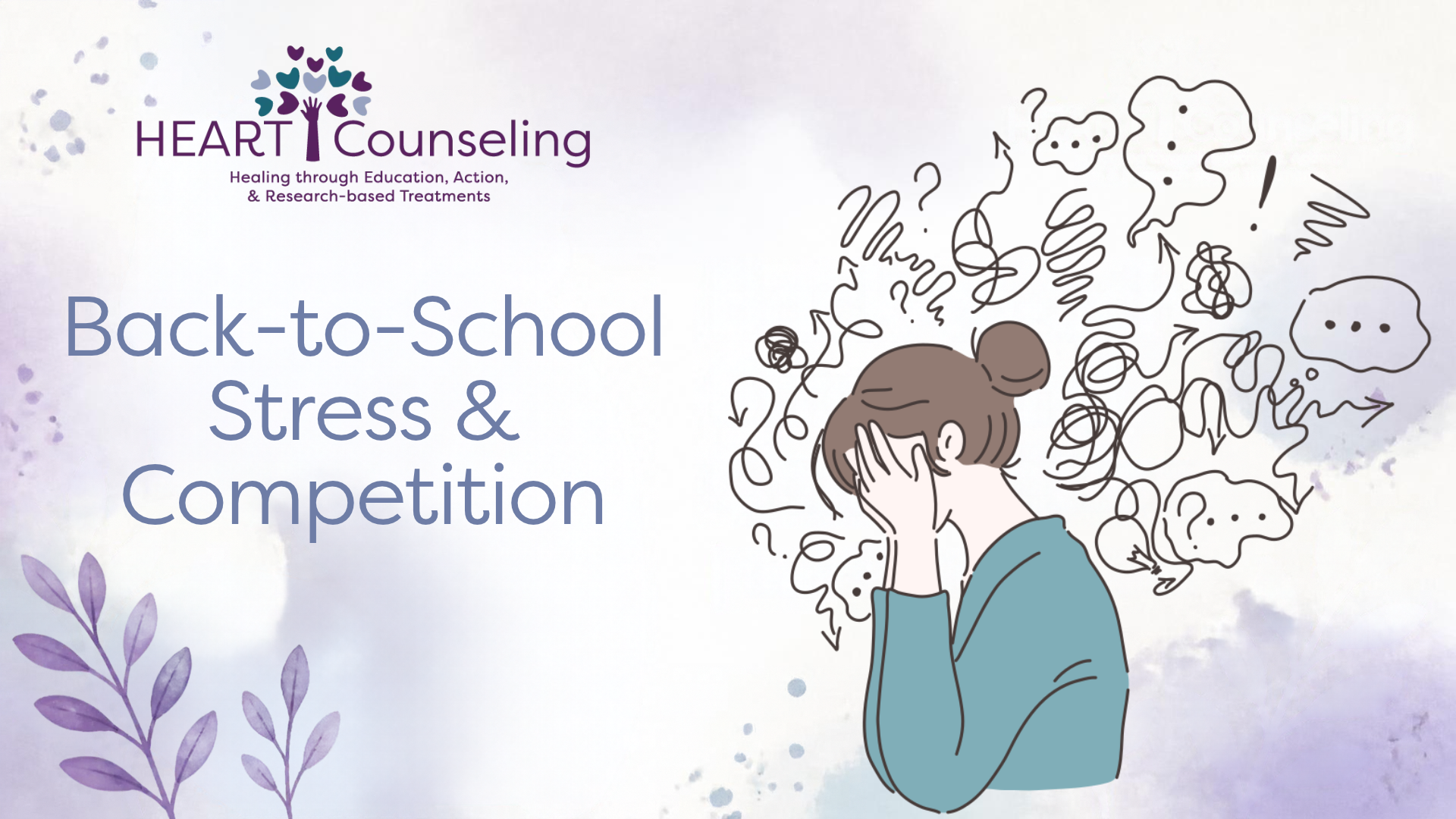
A new school year can bring new classes, new people, changing routines, and a long list of things we are suddenly expected to manage. whether you are starting another year of high school or moving into college, some back-to-school stress comes with the territory. However, when stress starts affecting sleep, relationships, motivation, or your ability to get things done, paying attention to your mental health as a high school or college student, or the parent of a teen or college student, matters.

Get gentle monthly support and mental health tips from the HEART Counseling team — direct to your inbox.
Written By: Elise Reichle, APSW
Struggling to keep on top of all the demands of school?
You may have bought a planner and stopped opening it by week three. Maybe you know an assignment is due, but every time you think about starting, you find yourself scrolling, cleaning your room, or doing almost anything else (we call this “productive procrastination”). You might even be continuously telling yourself you need to “get it together,” while also wondering why the students around you seem to be handling things just fine when you are having a hard time.
You might have a voice in the back of your head, that is being really hard on you. It might be saying that you’re a failure if you can’t get the SAT score you want, or that you will never be successful.
Sometimes, thew answer to the school-struggles is really just needing some extra support around time management and executive functioning. Other times, however, the unfinished assignments and procrastination are signs that something on a deeper level than your schedule needs attention.
Back-to-School Stress Is About More Than Just School
School takes up a lot of time, but it is not the only part of your life. You may also be balancing a job, sports, activities, family responsibilities, friendships, dating, finances, commuting, or figuring who you are and what you want your future to look like. Even more, college students have to manage meals, laundry, appointments, transportation, and having roommates on top of coursework for the first time.
Sometimes, having everything in one place to organize can help. Later in this post, we discuss how to build a weekly schedule around your life that actually can work for you – that means including class, studying, work, personal commitments, easting, and self-care, instead of planning as if school exists in a vacuum. Therefore, a realistic schedule should make room for being a person, not just being a student.
You also do not need a perfect productivity system. Paper planners, calendars, apps, weekly schedules, or simple to-do lists can all work, and the best method is one you can realistically keep using. If your current system makes you feel worse every time you look at it, changing the system is allowed.
Furthermore, I know the temptation to give up on a system altogether if you don’t use it perfectly for a week or so. Try to not give in to the temptation! Having any sort of system to help you stay organized still helps, even if you aren’t perfect for a period of time. In other words, something is better than nothing.
When Procrastination Is Actually Overwhelm
You know the feeling, and we know it all too well too. There is something you need to do, and you cannot make yourself start. You might wait for motivation, tell yourself you work better under pressure, or distract yourself until the deadline becomes impossible to ignore. Then you rush through the assignment, promise yourself next time will be different, and repeat the whole process.
First, don’t be hard on yourself. I find that often makes things worse, and doesn’t serve to actually motivate us in an effective manner.
Procrastination becomes a habit. It is a form of avoidance that often comes along with anxiety. It that seems to resonate with you, check out our blog post on anxiety that discusses the cycle of avoidance and why avoidance is self-reinforcing.
However, it can also connect with perfectionism, anxiety, fear, and overwhelm, all of which are barriers. If starting means facing the possibility of doing something badly, not understanding the material, or discovering how far behind you are, avoiding it is the much easier and less threatening option.
The problem is avoidance usually creates more stress later. One unfinished assignment becomes three, your sleep gets sacrificed to catch up, and the voice in your head becomes more mean. Therefore, what originally started as back-to-school stress can turn into a cycle of anxiety, avoidance, guilt, exhaustion, and even burnout.
Three Things to Try When Everything Feels Like Too Much
So, if these descriptions felt like they resonated with you, what are you supposed to do?
Tip #1
Whatever task is most important, make the task smaller. Instead of “write my paper,” your first task might be opening the assignment instructions and reading them. I usually refer to this as breaking something down into a smaller “chunk.”
If the chunk you thought of still felt too daunting to start, break it down even more until it feels manageable! For example, maybe the first chunk is actually just to locate the assignment instructions. Chunking helps because it allows us top get started, no matter how small of a start, even if we dont have motivation. Again, something is better than nothing.
Tip #2
Second, when working on planning to overcome procrastination, try to look at your whole week instead of only today. Now I know, this is a very big and overwhelming ask – but hear me out. On a Sunday afternoon, take a dedicated hour to look at your demands for the week. This means your classes, work schedule, appointments, activities, study periods, and downtime before deciding where another task belongs.
Start by writing the things that are most important or have no “wiggle room” in your schedule first, and then work down from there. You can even build small chunks into your schedule! Moreover, looking ahead at exams and major assignments can help you notice difficult weeks before you are living through them.
Tip #3
Third, make your plan realistic. You need sleep, meals, breaks, friends, movement, and time when you are not accomplishing something. A sustainable routine needs consistency, flexibility, and balance; therefore, a schedule packed from morning until night is probably not a sustainable one. Savannah Buttermore, LPC-IT, one of our therapists here at HEART Counseling, talks about this more in her blog post on burnout.
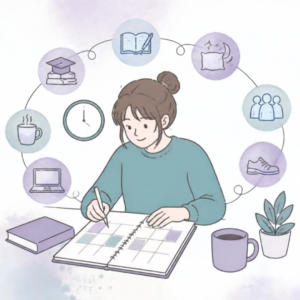
A realistic schedule makes room for school, responsibilities, relationships, rest, and being a person.
Your Mental Health: When the Usual Strategies Aren’t Enough
Trying a few strategies and still struggling does not automatically mean you are doing them wrong.
A calendar can remind you when your chemistry test happens, but it cannot tell you why thinking about the test makes your stomach hurt. To-do lists and planners might organize assignments, but it cannot resolve the anxiety making every assignment feel bigger than it is.
Pay attention to patterns. Maybe you are sleeping differently, withdrawing from people, constantly worrying about school, losing interest in things you usually enjoy, or feeling exhausted even when you have had time to rest. Perhaps one bad grade feels less like disappointing news and more like proof you are failing at everything.
This is where your mental health deserves the same attention you give grades, sports, college applications, or other responsibilities. You do not need to wait until everything falls apart before telling someone you are struggling. Support can start while you are still going to class, turning in assignments, and appearing “fine” to everyone around you.
The bottom line is – being successful in high school, and often times in college, is more stressful and mentally more difficult than it was for our parents.
Some parents won’t like hearing that, but its the truth. Today there is more competition among peers (in order to get where you want you have to be perfect at school, sports, and juggle as many extracurriculars as possible), added social stress and pressure with social media, and more pressure to be academically successful – so much so that, unlike during the 80s, you don’t have to be a bad student to be cool!
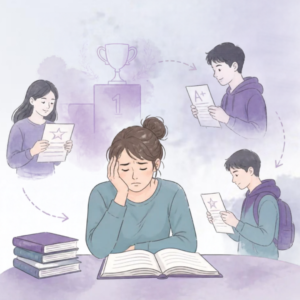
When school starts feeling like a constant competition, academic pressure can become difficult to leave in the classroom.
This is where, especially for my teens out there, it can be difficult to advocate for yourself – especially if your parent has a different viewpoint than you. This is where therapy can be a safe space to receive support for everything that you are going through, and we dont bring judgement or biases. Your well-being is always our #1 priority.
College Student Mental Health and Learning to Do Life Differently
College brings a strange combination of independence and pressure. You may have more control over your schedule than ever before, while also having fewer people noticing when you stop sleeping, skip meals, miss class, or fall behind. Moreover, homesickness, friendships, roommates, finances, identity, relationships, and uncertainty about the future can exist alongside the increased academic stress.
Building-in structure and ways to keep yourself accountable can make this transition easier. Our existing blog post about Transition to College Tips for New Students recommends staying connected to campus, respecting your limits, and using available support rather than waiting for a crisis. Planning tools can help too, especially when you use monthly planning for the big picture, weekly planning for routines, and daily planning for manageable next steps.
Still, the mental health challenges faced by college students cannot always be managed with better organization. You can have a color-coded calendar and still be anxious, and you can attend every class and still feel lonely, and you can get good grades while privately feeling exhausted.
You Don’t Have to Earn the Right to Ask for Help

Don’t wait until everything falls apart before telling someone you are struggling.
Students sometimes assume therapy is for people who are struggling more than they are. You might tell yourself other people have bigger problems, your stress will pass after midterms, or you should be able to handle this yourself. However, support does not need to be reserved for your worst semester or your worst day.
Just like it is better to go get a “check-up” at the doctor than only going to the emergency room when you need it most, proactive mental health management, and early intervention for students of all ages, is better.
What Does Therapy Actually Look Like?

Meeting with a therapist can give you a place to talk through school stress, anxiety, relationships, and whatever else feels too hard to carry alone.
Therapy can help you understand what happens when you shut down, avoid, overthink, or put impossible expectations on yourself. It can also help you notice patterns involving anxiety, depression, trauma, relationships, life transitions, or the pressure you feel about school and your future. The goal is not to turn you into a perfectly organized student.
Often times, it is to receive extra support, acknowledgement that you are doing difficult things, and extra help and space to become the best, most capable version of yourself – without the outside pressure.
In my own work with teens and young adult students, I have found that our work together often focuses on helping students to understand themselves , and finding ways to move through difficult moments with grace, as opposed to fighting yourself the entire time. For some students, therapy becomes one part of the support system alongside friends, family, professors, advisors, school counselors, or campus resources.
Looking for an Anxiety Therapist Near You in Madison, WI?
If you are a teen or college student in Madison or the surrounding area, you do not have to wait for a crisis to consider therapy. Maybe back-to-school stress has become difficult to manage. You might be noticing changes in your mood, sleep, motivation, relationships, or ability to concentrate. As experienced anxiety therapists, we can offer a place to talk about what is happening without reducing the problem.
Parents can help here, too. If your teen keeps struggling despite planners, reminders, tutoring, conversations, or consequences, consider getting curious about what might be underneath the behavior. Our Back to School Mental Health Tips for Parents of Teens offers additional ideas for replacing pressure with curiosity, shifting from fixing to coaching, and recognizing when stress becomes something more.
A school year does not have to go badly before you ask for support. HEART Counseling works with teens and young adults in Madison, WI navigating anxiety, depression, trauma, school stress, life transitions, relationships, and the move into greater independence. If this semester feels heavier than expected, reaching out can be one way to stop carrying all of it by yourself.

Ready for extra support? Meet with one of our Madison therapists and start your next chapter.
About the Author: J. Elise Reichle, APSW, is an advanced Practice Social Worker and therapist at HEART Counseling. She works with teens and adults using trauma-informed approaches like Internal Family Systems (IFS), CBT, and psychoeducation in therapy for trauma and anxiety to support healing and growth.
Share this story...

Heart Counseling is a team of therapists specializing in helping kids, teens, and adults with anxiety and anyone who has experienced an upsetting event. Our mental health therapists are also passionate about perinatal mental health and helping parents at all stages. From kids to adults, we are dedicated to helping you and your family thrive.