
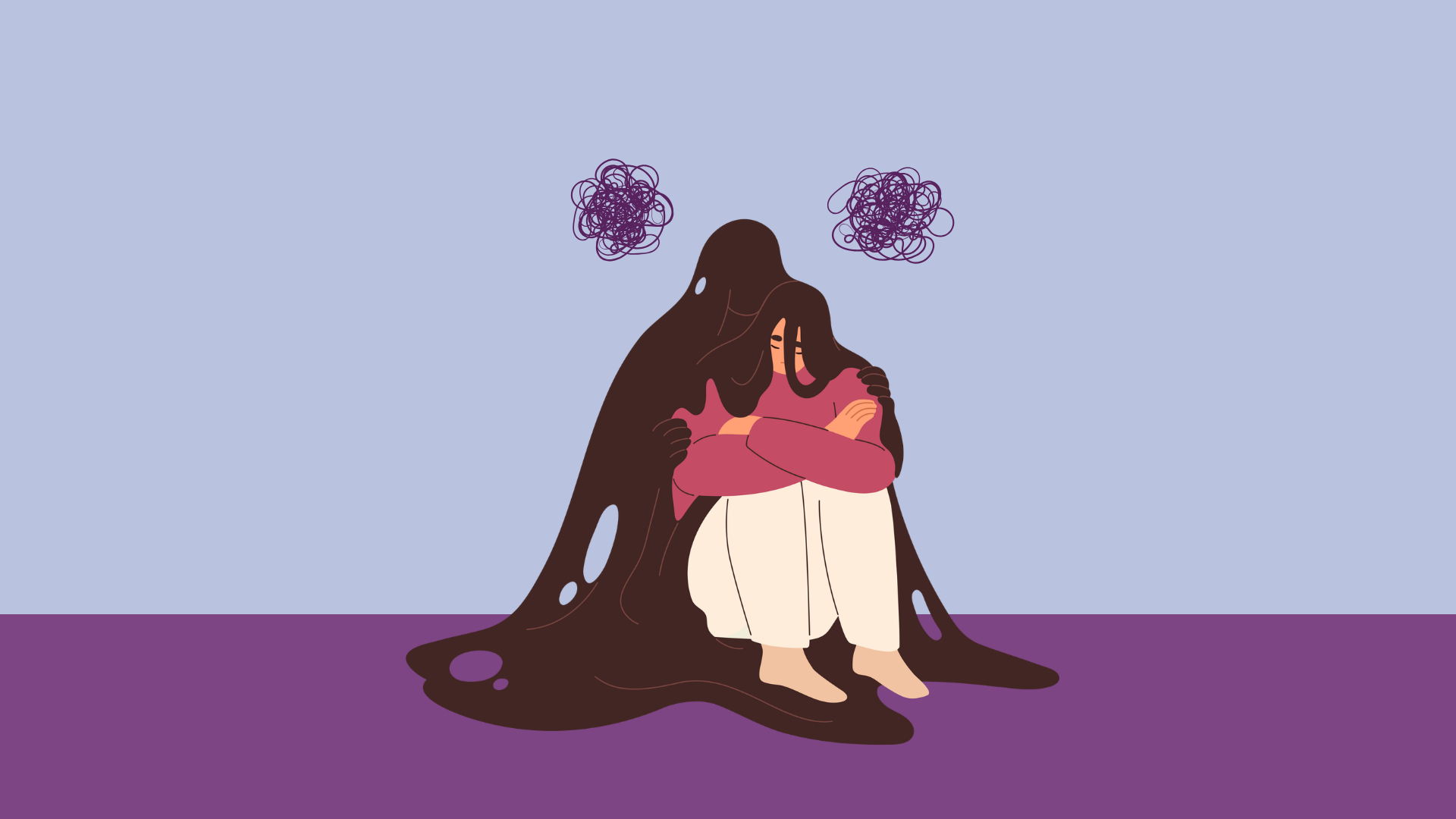
Anxiety 101 | What it is, Why We Avoid it, and What Helps
Written By: Elise Reichle, SWTC (Social Work Training Certificate) and Graduate Intern

Get gentle monthly support and mental health tips from the HEART Counseling team — direct to your inbox.
Anxiety 101
Anxiety makes things that we perceive as threats feel intense, urgent, and terrifying, even if they aren’t in reality. Even more, anxiety itself feels never-ending, making it even more difficult to reason with ourselves in the moment.
Why Humans Experience Anxiety
All of these characteristics make anxiety feel like a primal, deeply evolutionarily rooted emotion. What do I mean by “evolutionarily rooted?” I often describe it to clients by comparing anxiety to the feeling of nausea.
We have all at some point or another gotten sick and felt nauseous. The feeling of nausea is, in my opinion, all-consuming, extremely uncomfortable, and very difficult to ignore or divert our attention from. Of course, if we can manage to forget about it, distract ourselves from it, or divert our attention, that’s great! However, the process of actually breaking away from that overwhelming feeling of discomfort is usually not so simple.
Naturally, anxiety is a similarly overwhelming and all-consuming feeling. Also, I find that anxiety is more difficult to forget about or distract ourselves from than other emotions (like being sad or disappointed or scared). To me, anxiety has always felt like a state of being.
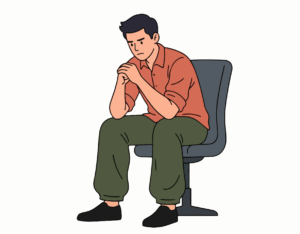
Anxiety can make it difficult to pull our attention away from worry, even when we know logically that we are safe.
Modern Day Anxiety
That is not to say that anxiety serves no useful purpose. In fact, it is a very adaptive and positive trait in many ways. Just like nausea caused animals to rid their bodies of harmful things they had consumed, anxiety also keeps us safe from harm. From an evolutionary perspective, I often find myself saying that anxiety protects us from “the lion in the bushes.” The only thing is. . . we don’t have to worry about being unexpectedly attacked by lions in the 21st century.
Although the risks we face are less directly harmful, anxiety still serves this same purpose today.
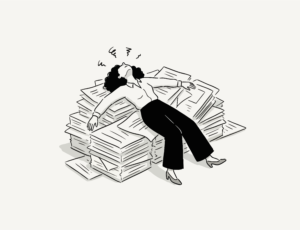
Sometimes anxiety looks less like shutting down and more like constantly pushing ourselves to keep up.
The Self-Reinforcing Nature of Anxiety
For example, say you have an upcoming presentation to give to classmates or coworkers. You might experience anxiety in the form of several “What if?” questions that pop up in your mind. These might sound like:
What if . . .
- I mess this up?
- They think I’m incompetent?
- My presentation topic is actually completely wrong? ‘
- They hear my voice shaking, or see my hands shaking?
- I freeze up?
Sometimes the thing we become afraid of isn’t even the situation itself anymore. We become afraid of the anxiety we expect the situation to cause.
Anxiety and Psychoeducation
When discussing anxiety with clients, I often use psychoeducation to help my clients intervene in the positive-feedback loop that is anxiety (more on this later).
This is part of what makes anxiety so frustrating. You can know logically that you’re safe, but you and still feel your heart racing. You can recognize that a thought is unhelpful, or your worries are unlikely to occur, but still find yourself going through every possible future outcome.
However, as a result of all this excessive worry and distress, many people with anxiety will usually combat it by overpreparing for their presentation to decrease the risk that these things will actually happen.
This is also why, as therapists, we often find significant overlap between high-achieving students and anxiety. In the 21st century, anxiety no longer protects us from being blindsided by a lion in the bushes, but it helps us to avoid failing an assignment or a presentation, or missing a deadline.
If this seems to resonate with you, it may help to know that we can often find some comfort, relief, and compassion for the anxious parts of ourselves when we are able to understand what our anxiety is trying to do, and how we might be inadvertently making it more intense.
Anxiety Isn’t the Enemy
Anxiety is a normal human emotion, and it has a purpose.
At its core, anxiety is the feeling of anticipation associated with a potential future threat. The most important parts of this are potential and future. It is important to remember that anxiety doesn’t mean something bad is happening or will happen (even though it feels that way). In reality, it means our brains and bodies have detected a threat that could happen, and it is preparing us to respond.
Anxiety is Adaptive
Anxiety is normal and adaptive. A certain amount can motivate us to study for a test, prepare for an important conversation, notice potential danger, or think ahead about a problem.
Often times, anxiety does assist us in positive ways! We don’t actually want a life completely without anxiety. Anxiety is one of the systems our bodies use to keep us safe.
The Connection Between the Nervous System and Anxiety
However, if you have found yourself wishing you didn’t have anxiety, it is likely because your nervous system (the alarm system that we associate with anxiety) is too sensitive, staying activated for too long, or is going off at times where the situation isn’t dangerous enough to be triggering the alarm so intensely.
If you notice that anxiety is interfering with your ability to go places, do things, or interact with others, by interfering with work, school, relationships, and everyday activities, this is when anxiety may be more of a daily challenge than an adaptive trait.
Overthinking can feel productive, but anxiety keeps us searching for certainty we may never find.
Anxiety Often Speaks in “What If?”
As I mentioned earlier, one way to recognize anxiety is to listen for the phrase “What if…?”
For example: What if . . .
- I fail?
- They think I’m weird?
- This headache means something is seriously wrong?
- I panic while I’m driving?
- I don’t know what to say?
There’s nothing inherently wrong with asking what-if questions. Thinking ahead is useful ant times. Anxiety becomes more difficult when those questions consistently magnify the possibility of danger while minimizing our ability to cope.
Cognitive Behavioral Therapy (CBT) for Anxiety
Cognitive Behavioral Therapy (CBT), the gold standard treatment for (and one of several evidence-based treatments for) anxiety, is helpful for intervening in this cycle. Anxious automatic thoughts can involve magnifying threats, underestimating our ability to handle them, and predicting catastrophic outcomes (Kaczkurkin & Foa, 2015; Otte, 2011).
When we are worried, anxiety is really truly fantastic at identifying potential outcomes. Unfortunately, it is not very good at distinguishing things that are possible from things that are likely to actually occur.

Anxiety wants certainty about the future, even when certainty simply isn’t available.
Anxiety Can Be Very Physical
The feeling isn’t “just in your head.”
It can show up throughout the body. Depending on the person and situation, anxiety might feel like:
- racing or pounding heartbeat
- muscle tension
- shakiness
- sweating
- feeling hot or cold
- difficulty catching your breath
- stomach discomfort
- restlessness
- difficulty sleeping
- feeling on edge
Clinical descriptions of anxiety include physiological arousal alongside subjective fear, intense emotions, and avoidance. Research and diagnostic literature also recognize physical experiences such as muscle tension and sleep disturbance as possible features of anxiety.
These sensations are uncomfortable enough, and also add to existing worries by causing us to fear physical symptoms themselves.
For example, “What if this feeling gets worse?”
This is when anxiety starts to feed itself.

Anxiety involves both the brain and body, which is why it can feel so physical and difficult to cope with in the moment.
When We Become Afraid of Anxiety
Imagine that you’re standing in line at a crowded store and suddenly notice your heart beating faster.
You think, “What if I’m about to have a panic attack?”
That thought makes you more anxious.
Your heart beats faster.
Now the physical sensation feels like evidence that your original fear was correct.
“See? Something really is happening.”
Your anxiety increases again.
This can create a kind of positive feedback loop. We don’t refer to this loop as “positive” because it feels good, but because each part of the cycle increases the next part. As a consequence, the cycle creates a loop of constantly increasing anxiety that can be hard to stop or slow down.
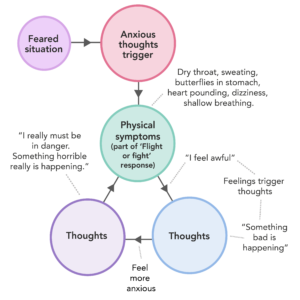
Anxious thoughts can intensify physical symptoms, and those sensations can trigger even more anxious thoughts. This graphic, from MindWell, shows this positive feedback loop.
Anxious sensation → anxious interpretation → more fear → stronger physical sensations → more anxious interpretation.
Why Anxiety Can Snowball
For some people, the fear eventually shifts from “I’m afraid of this situation” to “I’m afraid of what my anxiety will do in this situation” or even “I’m scared of what is happening to me right now.”
Research-supported approaches to panic treatment specifically work on changing how people react to the physical sensations and fears surrounding panic.
Understanding the cycle doesn’t instantly stop anxiety. However, when we are able to recognize it, “Oh, that’s my alarm system again” it gives us a chance to respond differently.

Anxiety is always looking ahead, trying to spot what might go wrong before it happens.
Avoidance Works, Which Creates a Problem
When we feel anxiety increase, the knee-jerk response is to get away from the source. This looks like canceling plans. Skipping the party. Rescheduling the appointment. Choosing to not make an important phone call. Asking someone else to handle it for us. Leaving a place when we start to feel anxiety. Opting to stay home altogether.
When the Brain Capitalizes on Avoidance
When we choose to avoid situations, we feel immediate relief! Our anxiety goes away, for the short term at least. However, there is a problem. The brain learns quickly.
Instead of learning, “That was uncomfortable, but I handled it,” your brain may learn, “Thank goodness I escaped. That situation really was dangerous.”
Now, the next time the situation comes up your brain has even more reason to sound the alarm.
People avoid situations because they fear anxiety returning, and that avoidance can become self-reinforcing over time. When people continuously fall into the trap of the “cycle of avoidance,” the relief reinforces the belief that we aren’t capable of handling the situation.
Over time, this makes anxiety a more intense and more frequent feeling.
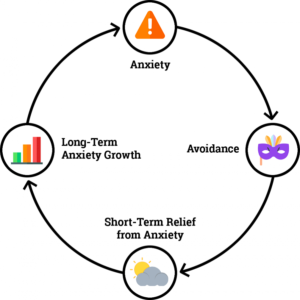
This graphic, from the OCD and Anxiety Center, shows how avoidance can make anxiety worse over time.
“Pushing Through” Anxiety Doesn’t Always Mean Forcing Yourself
Thankfully, there are ways to work on and decrease generalized anxiety other than just forcing ourselves to confront all terrifying situations head on. Working through anxiety also doesn’t mean shaming ourselves for being scared, or pushing ourselves past our limits.
If you do seek therapy for anxiety, we work through it incrementally and slowly.
One way to work through anxiety is to use an exposure-based approach. This might look like you and your therapist working together to construct a hierarchy of small steps towards the situation or goal. You start with the situations that are least anxiety-inducing, and slowly add steps of situations that are progressively more anxiety-inducing and worrisome. These steps should be specific and systematic.
What Gradual Exposure Actually Looks Like
For example, if someone feels anxiety when they have to get on an elevator, their exposure hierarchy might look something like this:
- Travel past an elevator
- Walk up to an elevator
- Go into an elevator, and walk out
- Go into an elevator, press a button, and walk out
- Walk into an elevator and stay inside for 5 seconds while holding the doors open
- Enter an elevator, let the doors close, and then reopen the doors on the same floor and walk out
- Ride up or down 1 floor
The Shift in Thinking
Each time we successfully complete 1 step of the hierarchy, our nervous system learns that elevators aren’t as much of a threat as it once thought. In your head, this might sound like:
- “Just because I feel anxious doesn’t mean I have to leave.”
- “I might feel anxiety now, but it will go away again.”
- “I don’t have to escape every uncomfortable feeling or situation.”
- “This won’t be nearly as bad as my anxiety anticipates.”
Exposure therapy is a key behavioral technique used in Cognitive Behavioral Therapy (CBT).
This isn’t to say that working through an exposure hierarchy is easy by any means. However, by breaking down anxiety-inducing situations into manageable steps and pieces, we can work through significant anxiety symptoms in a realistic and achievable way.
Please note, we do recommend constructing an exposure hierarchy with a therapist as opposed to on your own. By working with a therapist, you will have the support and help of a trained professional to ensure that you do not overwhelm yourself, attempt to move through the hierarchy too quickly, or feel ashamed if you aren’t able to complete a step, or get stuck.
Coping Skills Can Help Us Stay With the Feeling
Coping skills play an imperative role in working through anxiety, but they are more of a reactive response than a proactive response. The se skills include grounding activities, mindfulness techniques, and other strategies that help regulate your nervous system.
The goal of coping skills is not to make all your feelings of anxiety disappear. Instead, they help us stay grounded and calm enough to move or get through a situation with the less distress.
In my experience working with clients I have learned that coping skills are incredibly individualized. What works for one person might feel ineffective for another.
However, here is one kind of coping skill that seems to help most people.
“Box Breathing” or Diaphragmatic Breathing
These breathing techniques are the most universal and useful (in my opinion) because for most of us (whether we are aware of it or not) anxiety changes our breathing. By breathing in an intentional, controlled, calm, and regular manner, we kind of trick our nervous system into regulating itself.
This is because diaphragmatic breathing helps to regulate or “calm” our Vagus nerve, which then signals to our parasympathetic nervous system that everything is okay. Then, the Vagus nerve helps shut off the alarm that was being set off (Myerholtz, 2023).
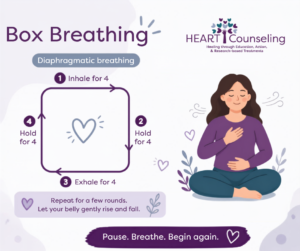
Breathing exercises help us become more aware of the other physical symptoms of anxiety, giving us an opportunity to respond to them differently.
Effectively, we are intervening to stop the anxiety reinforcement cycle.
There are several ways to remember “Box Breathing.” Some people refer to it as “Five Finger Breathing.”
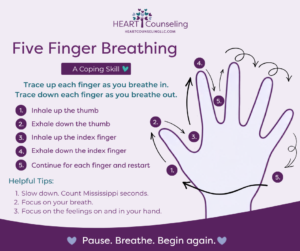
Five finger breathing pairs slow breathing with touch and movement, giving your attention something concrete to return to when anxiety feels intense.
However, I often recommend to clients that they follow a video to make things easier, similar to the ones linked below.
Practice Coping Skills When You Need Them Least
Importantly, don’t wait until you’re in an anxiety-crisis to practice.
Do breathing exercises when you’re calm too, so that you aren’t trying to learn something new when you are already panicked.
Listen To Yourself
Finally, if focusing on your breath makes you more anxious, don’t force it. Different grounding and relaxation strategies work for differently for each person.
The Goal Is Not to Rid Ourselves of Anxiety Forever
In my opinion, the most difficult part of anxiety to accept is that your anxiety will never completely go away. Some people just run more anxious. The best future outcome is one in which we change the way we engage with anxiety to be more intentional, controlled, and balanced.
Remember, anxiety, in itself, isn’t a bad thing. It’s part of being human. There will always be uncertainty in life. Many situations will be situations out of our control. There will be moments when our bodies respond before our brain catches up.
The one thing we can control is how we respond to the situation, and how we respond to anxiety when it does come up.
When Anxiety Starts Making Your World Smaller
Occasional anxiety is part of life. But it may be worth seeking additional support when anxiety begins interfering with your routines, relationships, work, school, sleep, or ability to do things that matter to you.
Sometimes that interference is obvious. Other times it gradually builds through avoidance.
Some individuals with intense anxiety can still be extremely high-functioning, as anxiety can push them toward perfectionistic patterns and high levels of performance (Ferber et al., 2024).
Anxiety can also go unnoticed by others when someone has gradually rearranged their life to avoid triggering situations.
How Therapy Can Help People Manage Anxiety
Therapy can offer a place to understand the anxiety cycle, learn to identify it, and learn what triggers it. Therapy also helps people gain insight into what the body does, what the mind predicts, what we can do to feel safer. Of course, it also helps those with anxiety to identify and practice coping skills and self care.
If you’re looking for an anxiety therapist near you in Madison, or looking for a virtual therapist from anywhere in Wisconsin, we are here for you.
All of our therapists have experience working with clients to help them better manage anxiety, and we can help you manage your anxiety in ways that are gradual.
You don’t need to expect yourself to become a person who never worries, and meaningful change is possible.
Everyone deserves support and help while working towards their preferred future.
Ready for extra support? Meet with one of our Madison therapists and start your next chapter.
About the Author: J. Elise Reichle is a Graduate Social Work Intern with her SWTC at HEART Counseling. She works with teens and adults using trauma-informed approaches like Internal Family Systems (IFS), CBT, and psychoeducation in therapy for trauma and anxiety to support healing and growth.
References
Antonia N. Kaczkurkin & Edna B. Foa (2015) Cognitive-behavioral therapy for anxiety disorders: an update on the empirical evidence, Dialogues in Clinical Neuroscience, 17:3, 337-346, DOI: 10.31887/DCNS.2015.17.3/akaczkurkin
Christian Otte (2011) Cognitive behavioral therapy in anxiety disorders: current state of the evidence, Dialogues in Clinical Neuroscience, 13:4, 413-421, DOI: 10.31887/ DCNS.2011.13.4/cotte
Ferber, K. A., Chen, J., Tan, N., Sahib, A., Hannaford, T., & Zhang, B. (2024). Perfectionism and social anxiety: A systematic review and meta-analysis. Clinical Psychology: Science and Practice, 31(3), 329–343. https://doi.org/10.1037/cps0000201
MindWell (2026). https://www.mindwell-leeds.org.uk/myself/exploring-your-mental-health/anxiety/the-vicious-cycle-of-anxiety/
Myerholtz L. (2023). Take a Deep Breath. Family medicine, 55(4), 284–285. https://doi.org/10.22454/FamMed.2023.731271
The OCD and Anxiety Center (2026). https://theocdandanxietycenter.com/understanding-the-cycle-of-anxiety/
Share this story...

Heart Counseling is a team of therapists specializing in helping kids, teens, and adults with anxiety and anyone who has experienced an upsetting event. Our mental health therapists are also passionate about perinatal mental health and helping parents at all stages. From kids to adults, we are dedicated to helping you and your family thrive.