
Internal Family Systems (IFS) Therapy in Madison, WI: Understanding Your Parts with Compassion
Written by Amberly Stevens, LMFT, AAMFT Approved Supervisor in Madison, WI

Get gentle monthly support and mental health tips from the HEART Counseling team — direct to your inbox.
What Is Internal Family Systems (IFS) Therapy?
Internal Family Systems is one of my personal favorite models to use as a therapist. It allows me to be creative and intuitive while truly meeting clients where they are. My clients and I collaborate to understand their internal system, their parts, and their innate capacity for healing and adaptation. Initial research has found links between IFS and positive outcomes for individuals with depression and PTSD. Multiple studies have found increases in self-compassion after completing IFS-based therapy.
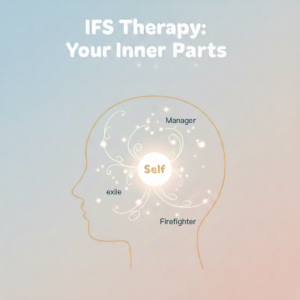
Developed by Richard Schwartz, the IFS model invites us to get to know the many different aspects of ourselves: our brains, our personalities, and our inner world. These parts are all important. They work hard in their own ways to keep us safe, even though their efforts can sometimes make life more difficult. In IFS, there are three main types of parts: managers, firefighters, and exiles.
Exiles: The Vulnerable Parts We Protect
Exiled parts usually develop early in life and represent young, vulnerable, and sometimes deeply shameful experiences. For example, someone who was abandoned by a parent at a young age may carry an exile that holds the belief, “I am unlovable.” Because these parts are so rooted in the past, and often connected to early experiences, it can feel incredibly unsafe to let others see them.
Managers and Firefighters: How Our Parts Try to Keep Us Safe
This is where managers and firefighters come in. Manager parts work hard to protect us by keeping attention away from our exiles. This might look like someone over-performing in a relationship so their partner has no reason to leave and trigger that vulnerable “I am unlovable” part.
If things start to feel too dangerous, firefighter parts may take over. These parts often respond quickly and intensely, sometimes through unhealthy coping strategies such as impulsive behavior, substance use, or, in more extreme cases, self-harm or suicidal thoughts. What’s important to remember is that these parts are doing their best to help. They are simply carrying out their “jobs,” without realizing that their methods may cause more harm than good.
Internal Family Systems in therapy is not Dissociative Identity Disorder (DID)
To be clear, working with parts in therapy is not the same as having Dissociative Identity Disorder (DID), previously known as Multiple Personality Disorder. DID involves inhabiting multiple distinct personalities in daily life, often with memory gaps between them.
Parts work in IFS is very different. It’s a way of understanding how the brain adapts to experiences, not a loss of identity or awareness.
Using IFS to Connect With Yourself in Healing
Parts work in therapy can look many different ways, but at its core, it’s about connecting with your curious, compassionate, clear, confident, and creative self. In IFS, this is called your “Self” or “Self-energy.”
The model is grounded in the belief that you already have what you need to heal, and that healing comes from within, not from someone else trying to fix you.
Why IFS & Parts Work is So Powerful
I’ve experienced parts work both as a client and as a therapist, and I’ve seen firsthand how powerful it can be. When people come to therapy, they usually want relief. Much of the work involves understanding the parts of the brain that formed in response to specific experiences. These experiences can look like trauma, abuse, neglect, or deeply internalized beliefs shaped through interactions with the world.
When we can identify these parts and work with them, they can shift into healthier, more adaptive roles.
What Internal Family Systems Looks Like in Therapy
So what does this actually look like in therapy? When I notice something that feels like a part, I invite the client to get curious about it. I might guide them through an intervention to help “flesh out” that part and get to know it better.
I may ask questions like:
- How do you feel toward this part?
- How old is it?
- How old does it believe you are?
- What is its job?
- What would it want to do if it didn’t have to work so hard?
When clients connect with a part, their responses are often intuitive, even if they don’t seem logical at first. We stay curious together. Over time, we may discover that one part is protecting another, or that a part believes the client is much younger than they actually are. Maybe it holds a deep, unspoken hurt. Through the IFS process, these parts can eventually be integrated and transformed into something more supportive and healing.
Interested in Exploring IFS Further?
If you’re curious about working with an IFS therapist, or want to consult with one of our therapists who specialize in IFS here at HEART Counseling LLC, please reach out to us! Our clinicians Amberly Stevens and Robin Kinney specialize in IFS. They have experience with, and a passion for, using the IFS model.
Our clinicians Amy Racki, Hollie McCrea Olson, and Sunshine Stephens currently incorporate the systems perspective into their approach and are continuing training to further refine their use of IFS.
Our graduate interns, Elise Reichle and Savannah Buttermore, are observing and learning from our Internal Family Systems therapists and continuing their own training on using IFS, implementing it with their own clients.
If you’d like to begin exploring your own parts outside of therapy, we also recommend the book No Bad Parts by Richard Schwartz!
Ready for extra support? Meet with one of our Madison therapists and start your next chapter.
Share this story...
Heart Counseling is a team of therapists specializing in helping kids, teens, and adults with anxiety and anyone who has experienced an upsetting event. Our mental health therapists are also passionate about perinatal mental health and helping parents at all stages. From kids to adults, we are dedicated to helping you and your family thrive.